
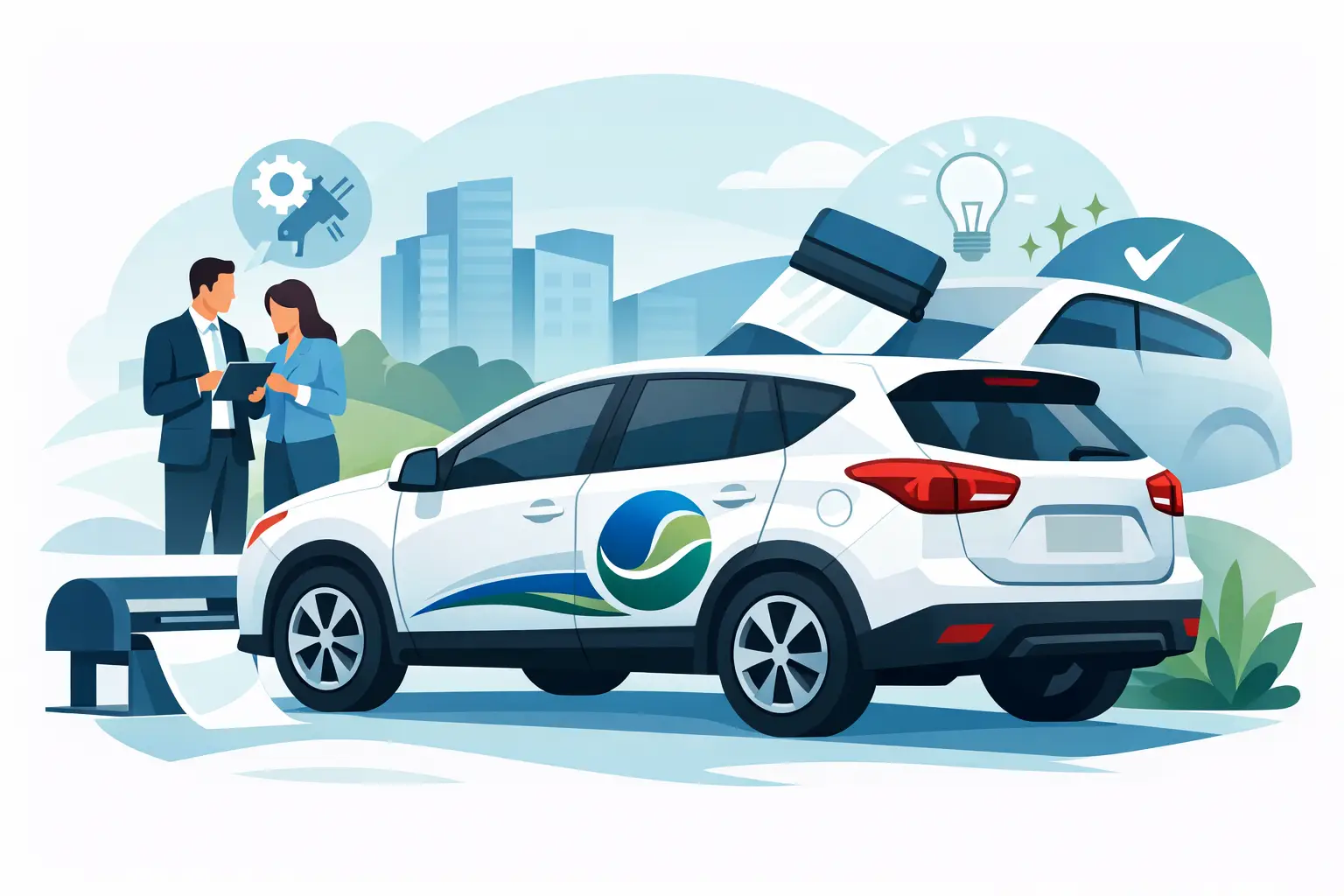
A parked truck at a jobsite, a sales rep pulling into a client lot, a delivery van stopped at a red light – every one of those moments is ad space you already paid for. Business logo car decals give you a simple way to put your brand in front of local customers without buying ongoing media.
For small businesses, the appeal is obvious. You need something that looks professional, holds up outdoors, and does not require wrapping an entire vehicle to make an impact. A well-made decal can handle that job. The catch is that not every logo, material, or placement works equally well once it leaves the screen and goes onto paint or glass.
Why business logo car decals still earn their keep
Vehicle graphics work because they meet people where they already are. Your car, truck, or van is moving through neighborhoods, parking lots, office parks, and highways all week long. That kind of repeated visibility builds familiarity fast, especially for service businesses that depend on local recognition.
This is also one of the more flexible branding options available. A full wrap creates maximum coverage, but it also costs more and locks you into a larger install. Decals are leaner. You can apply a company logo to doors, rear windows, tailgates, or side panels and get a clean branded look without turning the whole vehicle into a rolling billboard.
That matters for owner-operators, contractors, real estate teams, mobile detailers, landscapers, and anyone using a personal or mixed-use vehicle for work. You can keep the branding focused and still look legitimate on the road and at the curb.
What makes a business logo decal effective
The best decal is not always the biggest one. It is the one people can read quickly. On a moving vehicle, attention is short. If your logo has thin lines, tiny taglines, or low-contrast colors, it may look sharp on a business card and disappear on a truck door.
Start with legibility. Your business name should be the first thing people notice. If your logo includes a symbol, make sure it still reads clearly at the size you plan to install. If it only works when it is large and detailed, you may need a simplified version for vehicle use.
Color matters just as much. Strong contrast usually wins. White lettering on dark paint, black on light paint, or bold brand colors that stand apart from the vehicle surface tend to read best from a distance. Metallics, shadows, and specialty effects can look great, but they should support readability rather than compete with it.
There is also a practical side. Curves, seams, body lines, textured trim, and window edges can all affect how a decal looks once installed. A design that seems centered on a template may need adjustment on the actual vehicle.
Size and placement decide whether people notice it
Door logos are the standard for a reason. They give you a flat, visible area that reads well when parked or moving through traffic. Rear decals can also work well, especially for vehicles that spend time in stop-and-go driving, but they usually need simpler layouts because the viewing window is shorter.
Side panel decals on vans and trucks offer more room for larger logos or added lettering. If you have the space, this is often where a business gets the strongest return because the graphic can be seen from farther away. Smaller cars can still carry effective branding, but the design has to be tighter and more disciplined.
Window placement depends on the material. Perforated graphics and some specialty applications can be useful, but for standard logo decals, solid vinyl works best on smooth surfaces where you want maximum color and crisp edges. Just make sure the placement does not interfere with visibility or local regulations.
Choosing the right material for business logo car decals
Outdoor durability is not optional. A vehicle decal has to deal with sun, rain, road grime, washing, heat, and cold. If the vinyl is low grade or the adhesive is wrong for the job, it will show up fast in peeling edges, fading color, or cracking.
Cut vinyl lettering and logos are a strong choice when you want clean, professional branding with no printed background. They are especially effective for business names, phone numbers, DOT information, and simple logo marks. Printed decals are better when your logo includes gradients, images, or more complex color transitions.
Finish is worth thinking through. Gloss usually gives the most punch and looks at home on painted vehicle surfaces. Matte can be a smart option if you want a more subdued look or need to reduce glare. Neither is universally better. It depends on the style of your brand and the color of the vehicle.
Lamination may also matter, especially for printed graphics that will see heavy UV exposure or frequent washing. It adds protection, but it also changes the final look slightly. If durability is the priority, the trade-off is usually worth it.
Design choices that help your logo sell while you drive
A business vehicle is not a brochure. You do not need to cram every service, every city, and every social handle onto the panel. The stronger move is to focus on the information people can absorb in seconds.
For most vehicles, that means your logo, business name if separate, and one direct contact point. A phone number is common for local service businesses. A website can work well if it is short and easy to remember. Trying to include too much usually weakens the whole layout.
Font selection matters too. Decorative scripts and thin typefaces can look custom, but they often lose readability at distance. Bolder, cleaner lettering tends to perform better on the road. If your official brand font is hard to read, this is one case where an adapted vehicle version makes sense.
Consistency across multiple vehicles also pays off. A fleet looks more credible when logos are sized and positioned the same way from one unit to the next. Even a two-vehicle operation benefits from that discipline.
When decals are enough and when you need more
Not every business needs a full wrap. If your main goal is identification, trust, and local awareness, a well-placed logo decal may be all you need. That is especially true for contractors, estimators, sales vehicles, and owner-operated businesses where clean branding goes a long way.
If you need high-impact graphics from a distance, want to cover mismatched vehicle colors, or rely heavily on mobile impressions, larger graphics or wraps may make more sense. The right answer depends on budget, vehicle type, and how the vehicle is used.
That is why modular branding works well for many businesses. Start with logo decals and essential lettering. If you want more coverage later, add larger panels, rear branding, or additional graphics as the business grows.
Installation can make or break the result
Even the best decal looks second-rate if it goes on crooked or traps air and debris underneath. Clean surface prep is the first step. Wax, dirt, and residue interfere with adhesion, and rushed installs usually show their mistakes later.
Flat panels are the easiest for most buyers to handle. Complex curves and deep body contours require more care. If the decal is large, measured placement matters. A logo that is slightly off-center on one door becomes very obvious once both sides of the vehicle are done.
Temperature matters as well. Install conditions that are too cold or too hot can affect adhesion and workability. Taking a few extra minutes on prep and alignment usually saves a lot of frustration.
Getting more value from every vehicle in your lineup
One branded vehicle helps. Several branded vehicles build repetition in a market. That is where business logo car decals start acting less like a simple sign product and more like a system for visibility.
If you run multiple vehicles, keep the branding structure consistent but adapt sizing to fit each model. A logo that fits a transit van door may need a different scale on a pickup or compact car. The design should look related, not forced.
For businesses that need a fast path from concept to finished graphic, online customization tools make a big difference. Being able to adjust fonts, colors, sizing, and layout before ordering cuts down on guesswork and gives you a better shot at getting the look right the first time. That practical control is a big reason businesses turn to specialists like eDecals.com when they need durable custom graphics without slowing down the job.
The best decal is the one that keeps working after the vehicle leaves the driveway. Make it readable, make it durable, and make it easy to recognize from across a parking lot.