
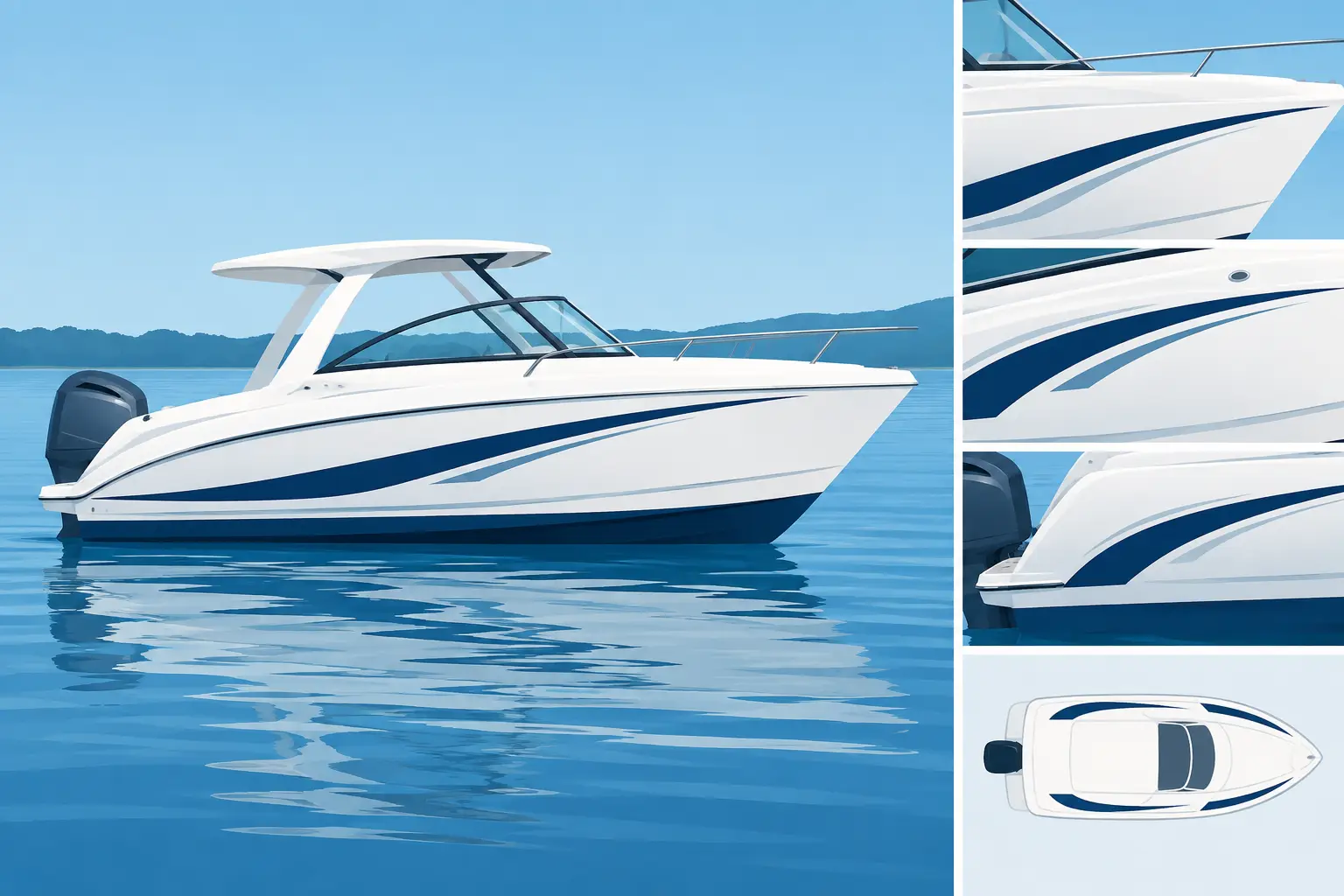
A boat name should look intentional from the dock, at the ramp, and from across the water. This boat name decal placement guide shows you how to choose a location, size, and layout that fits your hull instead of looking like an afterthought. Get the placement right before the vinyl touches the boat, and installation becomes much easier.
Start With the Boat’s Best Viewing Angle
Most boat names belong on the transom or the aft section of both hull sides. The right choice depends on how the boat is stored, docked, launched, and viewed. A cruiser with a broad, open transom gives you a natural canvas for a large centered name. A center console, fishing boat, pontoon, or wake boat may have more usable real estate along the rear quarter panels.
Stand 15 to 20 feet behind the boat and look at the transom as one complete shape. Ignore rails, lights, ladders, trim, and hardware for a moment. The cleanest placement is usually the largest uninterrupted area, with enough margin around the lettering to keep it from feeling crowded.
On side-mounted names, work with the body line instead of fighting it. A name generally looks best parallel to a strong rub rail, chine, or horizontal stripe. If the hull rises toward the bow, do not automatically follow that rise. Level lettering often reads better from a distance, especially on a name with multiple words.
Transom Placement
A transom is ideal when the boat has a broad, relatively flat panel and the name needs to be visible while moored or following another vessel. Center the design between permanent visual anchors such as the engine opening, swim platform supports, stern lights, or transom corners.
Do not place lettering so low that it disappears behind a motor, gets blocked by a trailer bunk, or sits close to the waterline. Keep clear of drain plugs, boarding ladders, trim tabs, exhaust outlets, and registration information. If the transom is heavily curved, a smaller design positioned in the flattest central zone will apply and read better than oversized lettering pushed into the curves.
Side Placement
Side placement gives the name visibility at the dock and underway. The aft third of the hull is the traditional choice because it balances the boat visually and avoids competing with the bow’s registration numbers.
Use the same height and distance from the stern on both sides. Measure from a fixed point, such as the back edge of the hull or a rub rail seam, rather than relying on your eye alone. On pontoon boats, choose a smooth panel that will not flex against the decal and avoid seams, rivets, rails, and access doors.
Size Your Boat Name Before You Order
Letter height should match the available panel, not just the length of the name. A short name like Reel Deal can use larger letters than a longer name like Weekend Forecast. Script fonts also need more horizontal room than block fonts, while outlines, shadows, and two-line layouts add visual weight.
A practical way to plan the size is to tape a piece of string or painter’s tape across the proposed area. Mark the maximum width that still leaves comfortable space around the design. Then make a paper template or use painter’s tape to create a rough rectangle at the planned letter height.
As a general rule, leave at least 2 to 4 inches of breathing room between the decal and nearby hardware, edges, stripes, or body lines. Larger boats can support larger margins. What matters is proportion: a name that fills every inch of a transom often looks cramped, while one that is too small gets lost in the hull.
For a long name, consider stacking it into two lines rather than shrinking the letters until they are hard to read. Put the primary name on the top line and a smaller hometown, port name, or tagline beneath it if desired. Keep the supporting line clearly secondary so the boat name stays readable at a glance.
Choose a Color Combination That Reads on the Water
Boat graphics are viewed in bright sun, shade, reflections, and low light. Contrast matters more than choosing the flashiest color in the design tool. White, silver, yellow, and light colors stand out on dark hulls. Black, navy, red, and darker colors usually read well on white or light-colored gelcoat.
If your hull has a busy paint scheme, metal flake, or a strong stripe, an outline can separate the letters from the background. A dark outline around light lettering, or a light outline around dark lettering, can make a major difference without making the design look overbuilt.
Think carefully about reflective effects and very thin fonts. They can look sharp up close, but may be less readable at a distance. For offshore boats, work boats, and boats that spend long days in direct sun, clean letterforms and high contrast usually win.
Make a Placement Template First
The most common boat lettering mistake is applying a perfectly made decal in the wrong spot. A simple template prevents it. Use low-tack painter’s tape to mark the top and bottom of the design area, then establish a centerline or a consistent reference point.
For a centered transom name, measure the total width of the available panel and mark its midpoint. Measure the decal width, find its midpoint, and align those two marks. Do not center by the first and last letters alone, especially with script fonts or designs that include flourishes. The visual center and the physical center can be different.
For side lettering, make a horizontal guide with painter’s tape. Step back several times during setup. A guide that looks level from two feet away can look noticeably crooked from the dock. If the boat is on a trailer, check that the trailer itself is level before using the ground or trailer frame as a reference.
Dry-fit the decal with the backing paper still attached. Check clearance around every nearby feature, including fuel fills, vents, rails, cleats, speakers, and storage doors. This is also the time to confirm that no portion of the decal crosses a sharp compound curve.
Apply Vinyl to a Clean, Stable Surface
Vinyl needs a clean, dry, wax-free surface. Wash the application area first, then remove wax, grease, sunscreen residue, and polishing compounds with an appropriate surface cleaner. Let the area dry completely. Freshly waxed gelcoat may look perfect, but it is a poor surface for adhesion.
Apply boat name decals in moderate conditions whenever possible. Extreme heat can make the adhesive too aggressive during positioning, while cold surfaces reduce tack. Avoid windy conditions that can pull a large decal out of alignment or blow debris onto the adhesive.
For most lettering, use the hinge method. Position the decal with painter’s tape across its center, lift one half, remove the backing, and squeegee from the center outward with firm overlapping strokes. Repeat on the other half. Keep the vinyl under control and work slowly around curves or tight spaces.
Do not rush the transfer tape removal. Pull it back slowly at a sharp angle, close to the surface. If a letter lifts, lay the tape back down and squeegee that area again. Once the transfer tape is off, press the lettering down around edges and details with the squeegee or a clean microfiber-wrapped finger.
Keep Decorative Names Separate From Required Markings
Your boat name is personal lettering. Registration numbers, validation decals, and other required identification are a separate issue and must follow the rules for your state and vessel type. Do not use a decorative name decal to replace required registration markings.
Keep adequate distance between the name and any mandatory numbers so both remain easy to read. On many boats, the bow is reserved for registration numbers while the transom or rear sides carry the boat name. That separation also creates a cleaner, more professional look.
Design for the Hull You Actually Have
A bold block font on a fishing boat, a classic script on a cruiser, or a clean modern style on a wake boat can all work. The best choice is the one that fits the available panel, stays readable in real conditions, and matches the personality of the boat.
Before you start designing your lettering, measure twice, mock up the placement, and give the design enough room to work. A properly positioned custom vinyl name turns a blank hull into a boat people recognize before they are close enough to read the registration numbers.